
From Brooklyn to Miami to Boston, business owners share how they navigate change while staying true to their values.
This article first appeared on Reuters Plus and is republished here with permission. Read the original article on Reuters Plus.
No two small businesses are the same: each has a purpose and character shaped by its founder’s vision and values. What all successful organizations have in common, though, is that they are fueled by perseverance and a strong connection to building and investing in their communities. Despite the term, small businesses have a major impact: they make up 99.9% of enterprises in the U.S., creating 62.3 million private-sector jobs.
A snapshot of three very different small businesses — including a nonprofit — located in East Coast cities between Massachusetts and Florida, shows that entrepreneurial spirit in the U.S. remains robust. With 3.1 million people filing to start small businesses in 2026 – up 17% from the same period in 2025 – what fuels this optimism at a time of economic uncertainty?
While new economic challenges influence the market now, it has been only a few years since businesses faced the ultimate resilience test during COVID-19 lockdowns. It was a crisis in which the owners of Heritage Foods in Brooklyn, N.Y., and Miami Lighthouse for the Blind and Visually Impaired in Florida found unheralded resilience through their ability to pivot, and through the trusted advisers like their business bankers who supported them in doing so, ingredients that caused optimism in trying times.
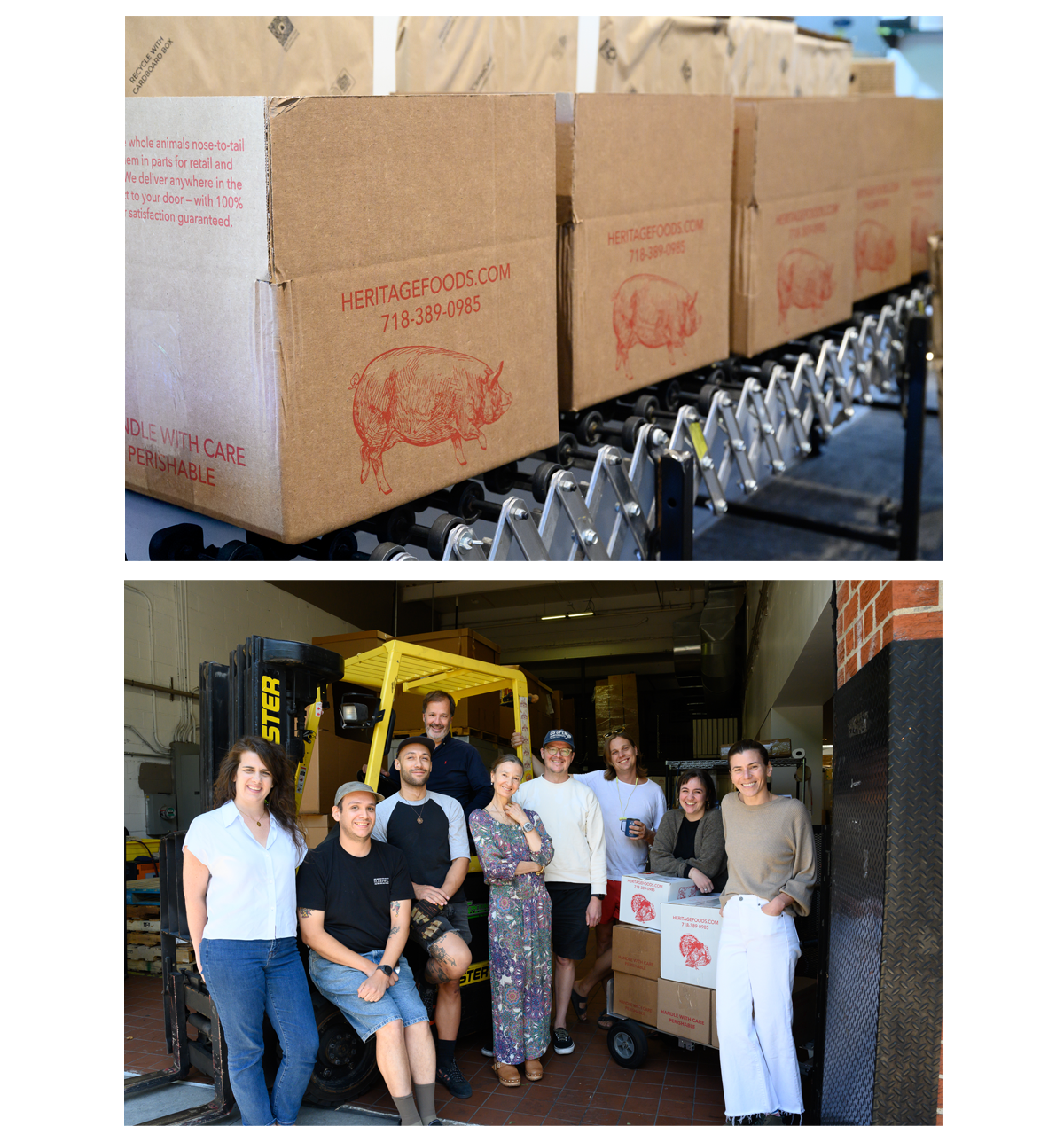
Patrick Martins, the founder of Heritage Foods, a wholesaler of responsibly raised, heritage-breed meats to top U.S. restaurants and individual customers, says that during the pandemic, when many meat industry giants were unable to deliver to customers, his much shorter supply chain never broke. Being small in scale offered flexibility that bigger organizations lacked in navigating change.
“All the restaurants had to come to us for stock, because some weeks the large meat suppliers just didn’t have enough. As a small distributor who only works with 30 farms and uses less-than truckloads (LTL), we could get our regular drivers to ship, say, three pallets of product to San Francisco, two to L.A., one to Vegas,” he says.
Martins credits Heritage Foods' relationship with the local TD Business Banking team with enabling continuity in the face of an unprecedented challenge.
The same held true for organizations with a very different balance sheet. When COVID-19 lockdowns limited how Miami Lighthouse for the Blind and Visually Impaired could deliver services to its clients and fund its programs, President and CEO Virginia Jacko had the same financial footing to rely on.
"From my experience, TD offers exceptional merchant account capabilities, and the TD Charitable Foundation has enhanced our Senior Group Activities Program," says Jacko. “Their donation, which Miami Lighthouse depended on, still came in during COVID-19 lockdowns.”
Because they mainly serve local or niche markets, small organizations' inherent understanding of their customers and communities' needs coupled with the agility to respond to changing market conditions drives their success. Adaptability and growth, however, can prove challenging for mission-led operations such as Miami Lighthouse or Heritage Foods.
“Heritage Foods has been in the business of preserving endangered livestock breeds since 2001, and anything other than organic growth is difficult, so making huge leaps and bounds isn’t possible for us,” Martins says.
Fortunately, its suppliers – the specialized slaughterhouses and tiny pig and turkey farms with which it works exclusively – are assured of consistent payments, thanks to Heritage’s relationship with TD, while Martins’ team of 12 works to keep going without sacrificing the company’s guiding principles.
Helping small businesses isn't only about growth, says Chris Ward, Head of Small Business Banking at TD Bank U.S. “It also helps our local communities, because small businesses are responsible for creating jobs. We rely on them every day, whether it's a dry cleaner, a gas station, or a grocery store. In that respect, small business is big business.”
Relationships matter
Business owners make their own luck in a competitive landscape, Martins believes, and for small-scale operators a lot of good can come from forging a strong relationship with a bank that understands what you do, what you stand for and what you need.
Jacko, who is herself visually impaired and leads an organization serving nearly 30,000 program participants annually, emphasizes the importance of financial institutions maintaining personal service and relationships.
“A big challenge for our clients is the growing emphasis on digital technology, which often excludes blind people. The fact that I can pick up the phone and talk to someone at the bank makes a huge difference: the telephone is a powerful tool. TD ensures not everything is only digital, and I applaud them for that.”

Maureen Collier, a TD client and the founder of Boston Balloon Events (BBE), which has operated since 1978, echoes that sentiment, saying, “It matters to me, as a business owner and as a customer, that I can still call and speak directly to a human at my bank.”
Like Collier, Jacko and Martins, many of TD’s small business and nonprofit clients aren't sitting in offices all day – they're out running their companies, Ward explains. “So they want tools that work on their phones as well as on a desktop computer.”
A personal connection
For Jacko, a strong banking relationship also means being recognized not only as an executive, but as an individual.

Her relationship with Miami Lighthouse began more than 20 years ago, when she relocated to Miami after becoming blind to receive vocational rehabilitation and employment training. A former financial executive at Purdue University, she went on to become president and CEO of Miami Lighthouse and founded its educational arm, Miami Lighthouse Academy.
In 2019, Jacko began a business banking relationship for Miami Lighthouse with TD. “From the first introduction, TD’s people saw me not as a blind person, but as an experienced executive interested in an impactful banking relationship. That caught my attention,” she says.
That emphasis on personal connection remains important as Miami Lighthouse adapts to new technologies. Jacko knows the nonprofit must continue to evolve to stay ahead, particularly as its clients learn and engage with technology like AI, which 61% of U.S. small businesses have actively adopted. “We must all learn how to use it but also know that it's not perfect. AI will never impact the need for one-on-one service.”
Her perspective shows how vital it is for a bank to get to know leaders and their organizations before recommending solutions.
“We need to diagnose before we prescribe,” Ward agrees. Not only does he want owners to feel comfortable asking for help, he believes the bank must be proactive in asking them how it’s going, what’s working, and what their concerns are.
This consistent approach is balanced with local expertise, Ward adds. “We’re a large bank that acts very local, with colleagues who understand local economies because they’re part of them.”
Supporting communities
That matters a lot to owners like Martins, who says banks like TD can help small business and nonprofit clients fulfill their missions in a variety of ways beyond products and advice.
TD’s recent Boston business summit attracted 180 customers, including BBE’s Collier. Founded and led by women, her company designs balloon sculptures, confetti drops, and cryo-jet visual effects for sporting events, parades, family parties and more, with the straightforward aim of putting smiles on faces while celebrating together. Providing products and services that have emotional resonance in a local community is a mark of success for many small businesses.
During a special July 4 Boston 250 celebration for the nation’s 250th anniversary, BBE supplied about 1,000 pounds of confetti for a parade and gathering attended by more than a million people. Such a large-scale organization can be challenging for small teams, but Collier’s relationship with TD made it easier because TD offered assistance so BBE would shine. Members of her local banking team operated BBE confetti jets in the parade, she says. “They really do care about their customers.”
This care is also evident in the bank’s investments in small business owners' own nonprofit work, including a Heritage Foods spinoff that consciously gives back. The Anne Saxelby Legacy Fund, named after Martins’ late wife and supported by TD, has sent 300 young adults on fully paid, sustainable farm apprenticeships.
“It's a way for youngsters to get completely immersed, living and working on a sustainable farm for a month,” Martins says. Many past interns stayed to work at the farms, he says, while others have gone on to similar jobs in other locations.
“In future decades, there will be a whole new army of young adults tuned into sustainable food production. It could create thousands of careers,” Martins adds.
Martins notes that working with TD is more than just finances, acknowledging how the relationship with TD helps Heritage Foods contribute to society, navigate change and move forward.
“They become sponsors [of our events]; or 20 TD people will show up to help run our charity auctions. Those are very big gifts for small organizations like ours," he says. “They are essentially in the small business owner’s corner, letting us do our best to succeed.”